Why a Designated Agent Is Required
An application reaches the Commission only through a designated agent, who carries the compliance duty for the file.
You can't apply for Vanuatu citizenship directly. A government-licenced firm, known as a Designated Agent, is legally required to submit your application. They are the mandatory gateway. These agents manage the entire process, from initial checks to the final submission to the Vanuatu Citizenship Office. Understanding their legal function is the first step to a secure and compliant application.
Vanuatu Designated Agent - A company licenced by the Vanuatu government under the Citizenship Act [CAP 112] and regulations, holding the exclusive authority to prepare and submit citizenship by investment applications to the Vanuatu Citizenship Commission on behalf of foreign investors.
What Are the Key Functions of a Vanuatu Designated Agent?
A Designated Agent is more than an advisor; they are the sole, legally mandated intermediary between you and the Vanuatu government for all citizenship by investment matters. This role is a core component of the programme's legal architecture, built to ensure compliance and security for everyone involved.
The agent’s primary functions are clearly defined. A 2024 European Commission report confirmed that these agents are solely responsible for all interactions with applicants. Their duties include:
- Marketing and Promotion: Presenting Vanuatu's citizenship programmes to potential investors globally.
- Initial Vetting: Your first hurdle. The agent conducts preliminary background checks to assess your initial eligibility. This crucial step happens before any significant fees are paid or official processes begin, preventing you from wasting time and money on an application that is likely to fail.
- Due Diligence Facilitation: They initiate the first layer of due diligence, submitting your details to Vanuatu's Financial Intelligence Unit (FIU) for screening. This is a mandatory prerequisite. You cannot proceed without it.
- Document Management: Providing a comprehensive checklist of required personal and financial documents and guiding you in compiling a file that meets the strict standards of the Vanuatu Citizenship Office.
- Formal Submission: Only the agent is legally permitted to submit the completed application file to the Citizenship Office for processing and consideration by the Citizenship Commission.
- Financial Coordination: Instructing you on the correct and secure channels for paying government-mandated fees and the final investment contribution once you are approved.
Essentially, the agent is a gatekeeper. They ensure that only complete and pre-vetted applications enter the government's official processing queue. This entire responsibility is underpinned by the framework of Vanuatu's Citizenship Act [CAP 112].
How Does Vanuatu Regulate Its Designated Agents?
To protect the integrity of its citizenship programmes, Vanuatu's government maintains strict control over who can act as a Designated Agent. A company can't just decide to offer this service. It must first survive a rigorous vetting and licencing process overseen by the Vanuatu Citizenship Commission.
The criteria for becoming and remaining a Designated Agent are stringent. As noted in European Commission findings, some key requirements include:
- The agency's principal must be a citizen of Vanuatu.
- That citizen cannot have acquired their own citizenship through an investment programme.
- All firms must maintain their main registered office in Port Vila, Vanuatu.
On top of that, agents must hold a specific business licence (Category F5: Designated Citizenship Agents) under the Business Licence Act [CAP 249] and provide a tax-clearance certificate to the Commission. This multi-layered regulatory framework ensures that agents remain accountable to Vanuatu's authorities.
Official records in early 2024 showed a slight discrepancy, with the Citizenship Office website listing 60 agents while the government provided a list of 71 to the European Commission. The lesson here is critical: before engaging anyone, you must verify your chosen agent against the most current, official list published by the Vanuatu Citizenship Commission itself.
What Is the Step-by-Step Application Process With an Agent?
The journey to obtaining Vanuatu citizenship is a structured, multi-stage process where your Designated Agent guides every single step. While timelines can shift based on case complexity and government workloads, the path itself is well-defined.
Agent Selection and Initial Payment: You choose a government-licenced Designated Agent and sign a service agreement. The process officially kicks off when you pay the initial government due diligence fee (typically US$5,000) and the agent's service fees. Your agent then submits your name for the mandatory Financial Intelligence Unit (FIU) background check.
FIU Clearance: This is a simple pass/fail stage. It’s a critical preliminary screening to confirm you have no major red flags and usually takes just a few days. A failure here stops the entire process before it truly begins.
Document Compilation: After FIU clearance, the agent gives you a detailed document checklist. This list is extensive, including certified copies of passports, birth certificates, police clearance certificates from your country of residence, proof of funds, and other personal records. Your agent reviews every document to ensure it meets all requirements before submission, as a single missing or incorrectly formatted paper can cause significant delays.
Formal Submission to Citizenship Office: Once the file is perfect, the Designated Agent formally submits your application to the Vanuatu Citizenship Office. The Office then reviews the file for completeness before it moves on to the Citizenship Commission.
Citizenship Commission Approval: The Citizenship Commission reviews the full application and the comprehensive due diligence report. If they approve your case, they will issue an "Approval in Principle" letter.
Final Investment and Oath: Upon receiving the approval letter, your agent will instruct you to make the full, non-refundable contribution to the government's development fund. After payment is confirmed, you must take an Oath of Allegiance. This can often be done remotely via video link or at a Vanuatu consulate, a process your agent will facilitate.
Citizenship and Passport Issuance: Once the oath is taken and registered, a Certificate of Naturalisation is issued. You are now an official citizen of Vanuatu. Your agent then immediately applies for your Vanuatu passport on your behalf. The entire process is known for being one of the fastest in the world, often taking around 2 to 4 months from submission to passport in hand.
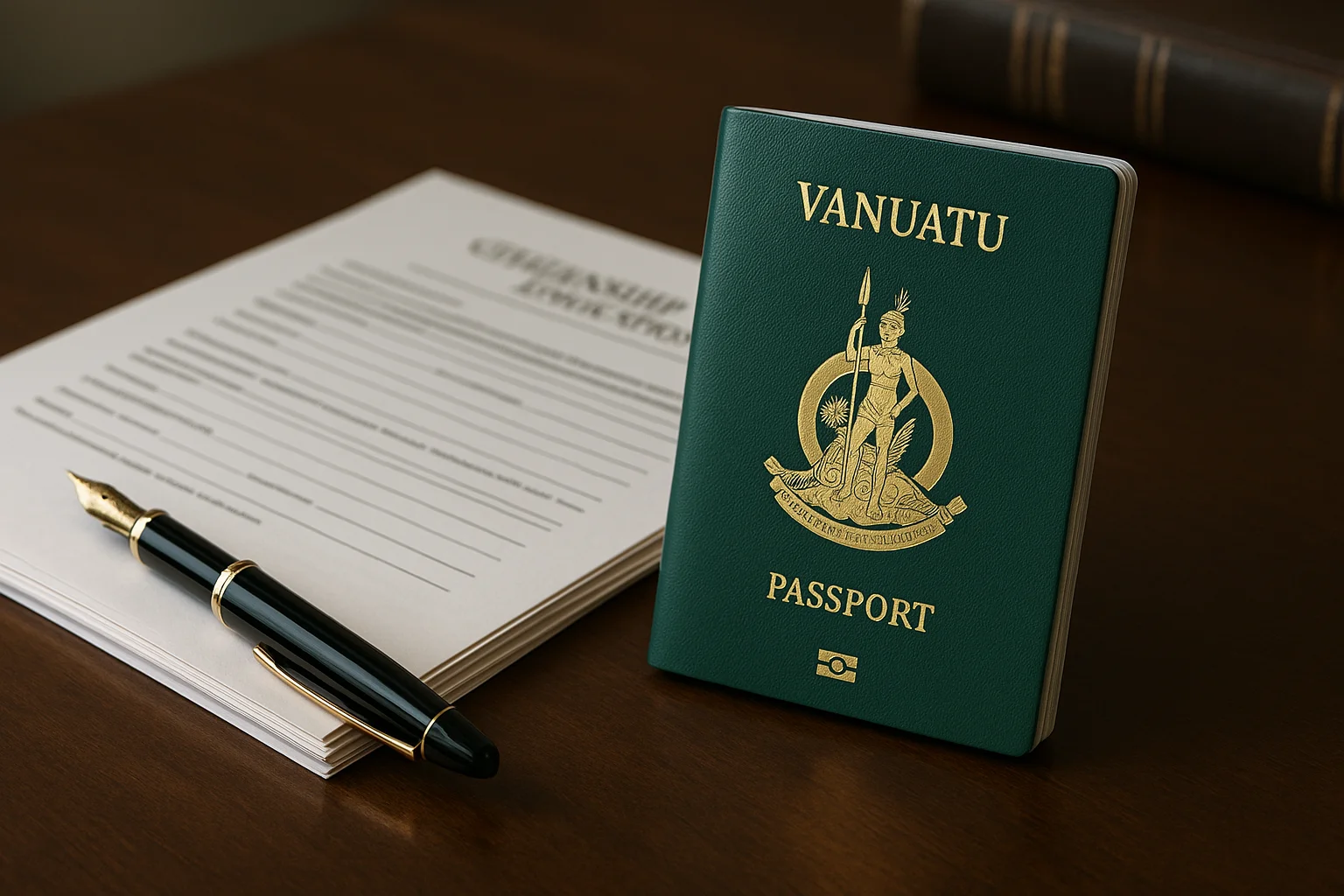
How to get Vanuatu passport
A Vanuatu passport is the final document issued after citizenship is granted—you cannot get one without first becoming a citizen. Once your Oath of Allegiance is complete and your Certificate of Naturalisation is issued, your Designated Agent submits the passport application to the Vanuatu Passport Office. This service is a standard part of their end-to-end management of your file.
Which Vanuatu Citizenship Programme Should You Choose?
Vanuatu has offered various routes in the past. Today, the primary and most direct path for investors in 2026 is the Development Support Programme (DSP). Designated Agents are fully equipped to handle these applications.
What is the Development Support Programme (DSP)?
The DSP is Vanuatu's main citizenship by investment programme. It grants full citizenship in exchange for a one-time, non-refundable financial contribution to a government fund used for national development and recovery efforts. The programme is enshrined in law and is the most common route for investors, with the contribution starting at US$130,000 for a single applicant.
Compare DSP with CIIP
You might see references to the Capital Investment Immigration Plan (CIIP). While both the DSP and CIIP lead to Vanuatu citizenship, their financial structures are very different.
- Development Support Programme (DSP): A pure contribution model. The amount is non-refundable and represents the full cost of the investment. It’s the most straightforward and predictable option.
- Capital Investment Immigration Plan (CIIP): This is a newer option involving investment into a government-approved fund, sometimes with a redeemable component. The cost implications, especially for families, can be more complex. It's worth noting that as of 2023, only three agents were approved to operate the CIIP.
An experienced Designated Agent can advise on the current status, availability, and suitability of each programme for your specific situation. For most applicants in 2026, the DSP remains the default choice.
What is Vanuatu Citizenship?
Vanuatu citizenship is the legal status of being a national of the Republic of Vanuatu. This status is granted for life. It is hereditary. It confers all the rights of a citizen, including the right to reside in Vanuatu indefinitely and the right to hold and travel on a Vanuatu passport.
What Are the Benefits and Realities of a Vanuatu Passport in 2026?
A key driver for seeking Vanuatu citizenship is the global mobility its passport provides. It is essential, however, that applicants have a clear and current understanding of its visa-free travel access.
Vanuatu passport ranking and visa-free countries
As of 2026, a Vanuatu passport provides visa-free or visa-on-arrival access to approximately 88 countries and territories. This includes important business and travel hubs like Hong Kong and Singapore.
Still, it is critical to note that historical access has changed. Following a review of the country's citizenship by investment programmes, the European Union suspended its visa-waiver agreement with Vanuatu on 4 February 2023. The United Kingdom followed suit on 19 July 2023. This means Vanuatu citizens now require a visa to travel to any country in the EU's Schengen Area and the UK. Any agent promising visa-free access to these regions is providing dangerously outdated and incorrect information.
Despite these changes, the passport remains a valuable tool for international travel, especially for individuals whose original passport offers limited mobility and for those looking to diversify their access within Asia.